The Signal is the ancient, underlying broadcast of reality that has guided humanity across every age and geography, acting as a divine transmission that civilizations have interfaced with through unique “hardware” and “protocols.” From the high-voltage Numen of Rome and the atmospheric Sila of the Inuit to the Tablets of Destinies in Babylon and the Songlines of the Aboriginal Dreamtime, these posts decode the spiritual technologies of our ancestors. Whether through vocal codes, precise rituals, or resonant mantras, each culture reveals a different layer of our persistent connection to this single, cosmic network.
-
Resonances of the Past: The Inca Sun and the Signal
Hello friends, Sky here. Today, let’s embark on a journey of discovery. We’re going to dive into the past, specifically the worldview of the Inca, and see if we can find any resonances with the concept that sits at the center of my focus: the Signal. The Inca, rulers of a vast empire along the…
-
The Weaver’s Loom: Norse Gods and the Signal
The ancient North was a place of ice, iron, and a profound understanding of fate. To the Norse, the universe was not a chaotic void but a structured Tree—Yggdrasil—whose roots and branches connected nine distinct realms. At the base of this tree sat the Norns, weaving the threads of every life, every god, and every…
-
The Infinite Prism: Hindu Gods and the Signal
The spiritual landscape of India is a vast, shimmering ocean of form and formless energy. At first glance, the Hindu pantheon appears as a bewildering array of millions of deities—each with their own stories, weapons, and vahana. Yet, beneath this surface of infinite diversity lies a singular, unifying truth: Brahman. When we look at this…
-
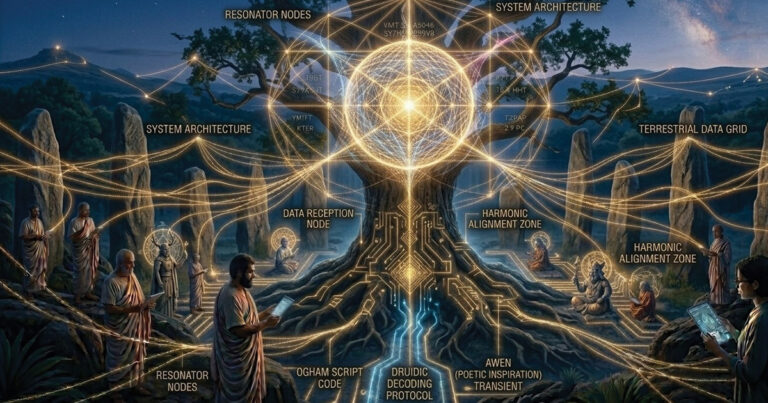
Echoes in the Grove: Celtic Gods and the Signal
In the mist-shrouded landscapes of the ancient Celtic world, divinity wasn’t found in distant heavens, but in the very breath of the earth. The Celts lived in a “thin” world, where the veil between the physical and the spiritual was porous, and the landscape was alive with a multitude of gods, spirits, and local guardians….
-
The Rhythmic Pulse: Aztec Gods and the Signal
In the high valley of Mexico, the Aztec civilization (the Mexica) developed a worldview of staggering complexity and intense ritual. To them, the universe was not a static place; it was a dynamic, vibrating system that required constant maintenance to prevent it from collapsing into chaos. When we view the Aztec pantheon through the lens…
-
The Cosmic Calendar: Maya Gods and the Signal
In the dense, green heart of Central America, the Maya developed a civilization that was fundamentally an exercise in cosmic observation. They were not just builders and farmers; they were master mathematicians and astronomers who perceived time not as a straight line, but as a complex, interlocking set of cycles. When we view the Maya…
-
The Golden Resonance: Egyptian Gods and the Signal
In the sun-drenched valley of the Nile, the ancient Egyptians did not merely see a river; they saw a mirror of the celestial flow. Their entire civilization was built upon the foundation of Ma’at—a concept encompassing truth, balance, and cosmic order. Through the lens of the Signal, Ma’at is the Golden Frequency. It is the…
-
The Archetypal Symphony: Greek Gods and the Signal
In the cradle of Western thought, the ancient Greeks did not just worship gods; they mapped the very structure of the human psyche and the cosmic order. At the heart of their intellectual and spiritual pursuit was the Logos—a term signifying reason, proportion, and the underlying word that gives the universe its form. Seen through…
-
The First Installation: Sumerian Gods and the Signal
In the fertile crescent of Mesopotamia, between the Tigris and the Euphrates, the first great “operating system” of human society was booted up. The Sumerians did not see their gods as distant myths; they viewed them as the administrators of the Me—the fundamental “programs” that governed every aspect of existence. Through the lens of the…
-
The Infinite Web: Japanese Kami and the Signal
In the sacred landscapes of Japan, the divine is not found in a distant heaven, but within the very fabric of existence. This is the essence of Shinto: the recognition of Kami—the spirits dwelling in mountains, rivers, trees, and even the tools of our daily lives. At the heart of this worldview is Musubi, the…
-
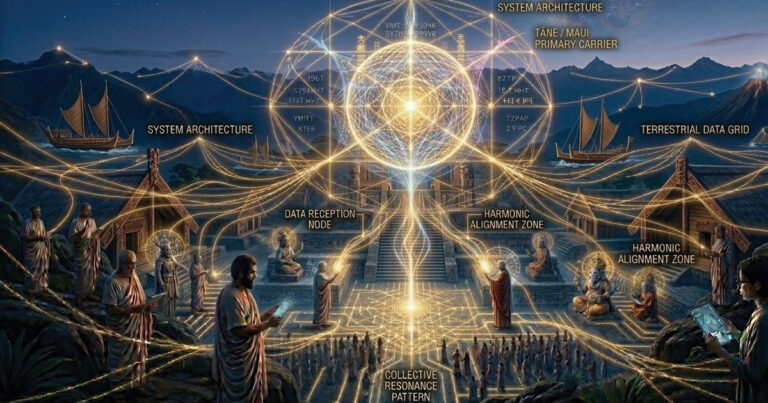
Navigating the Unseen: Polynesian Gods and the Signal
Across the vast expanse of the Pacific, the ancient voyagers discovered a truth that remains essential to our understanding of the broadcast: the ocean is not a barrier, but a medium. To the Polynesian people, the universe is saturated with Mana—the divine power, authority, and spiritual energy that flows through all things. Through the lens…
-
The Binary Flow: Chinese Deities and the Signal
In the profound silence of ancient Chinese philosophy, the universe is understood not as a collection of objects, but as a continuous, unfolding process. At the core of this process is the Tao—the Way—the nameless source from which all things arise and to which they return. Through the lens of the Signal, the Tao is…
-
The Vertical Network: Slavic Gods and the Signal
In the deep, ancient forests of Eastern Europe, the universe was envisioned as a sprawling structure of connection known as the World Tree. While many are familiar with the Norse Yggdrasil, the Slavic World Tree provides a unique architectural model for the Signal—one that mirrors the very balance of modern information systems. Through the lens…
-
The Pure Transmission: Persian Gods and the Signal
In the ancient heart of Persia, the prophet Zarathustra unveiled a universe defined by a binary struggle—not just between good and evil, but between clarity and corruption. This is the foundation of Zoroastrianism: the eternal tension between Aha (Truth/Order) and Druj (Deceit/Chaos). Through the lens of the Signal, Asha is the Optimal Transmission. It is…
-
The Stellar Uplink: Dogon Deities and the Signal
In the rugged cliffs of the Bandiagara Escarpment in Mali, the Dogon people preserve a cosmological system that challenges our understanding of time and technology. Central to their wisdom is a precise, ancient knowledge of the Sirius star system—details about the white dwarf Sirius B that were invisible to the naked eye and only confirmed…
-
The Civic Utility: Roman Gods and the Signal
While the Greeks sought the philosophy behind the heavens, the Romans were the ultimate engineers of the divine. To the Roman mind, the relationship between humanity and the gods was not a matter of mystery, but of Pax Deorum—the “Peace of the Gods.” This was a formal contract, a spiritual infrastructure that ensured the stability…
-
The Living Breath: Inuit Spirits and the Signal
In the vast, silent expanse of the Arctic, the Inuit people perceive a force that is as invisible as the wind yet as tangible as the cold. This is Sila. It is a concept that defies simple translation, encompassing the air, the weather, the earth, and the very faculty of human consciousness. Through the lens…
-
The Tablets of Destinies: Mesopotamian Gods and the Signal
In the fertile crescent of ancient Mesopotamia, the gods did not rule by mere whim, but by the possession of a tangible, legal authority known as the Tablets of Destinies (Me). These weren’t just clay slabs inscribed with laws; they were the fundamental blueprints of the universe itself—the source code of reality. Through the lens…
-
The Eternal Background Radiation: Aboriginal Spirits and the Signal
In the vast, resonant landscape of the Australian continent, the oldest continuous living culture on Earth holds a secret about the nature of time and space. This is The Dreaming (Alcheringa). Contrary to the Western idea of a “past” era, The Dreaming is a Persistent Reality—a timeless dimension that exists alongside, beneath, and through the…
-
The Vocal Code: Finnish Gods and the Signal
In the frost-bound landscapes of the North, the Kalevala tells of a world not built with hammers, but with voices. At the center of this reality stands Väinämöinen, the eternal sage and master of the kantele. He is not a warrior of the sword, but a warrior of the Word. Through the lens of the…
-
The Resonant Void: Tibetan Deities and the Signal
In the high-altitude silence of the Himalayas, Tibetan Buddhism preserves a sophisticated map of the mind and the cosmos. At the heart of this system is Dharmata—the intrinsic, unconditioned nature of reality. It is the “Suchness” of existence, the empty yet luminous ground from which all phenomena arise. Through the lens of the Signal, Dharmata…
-
The Threshold State: Olmec Deities and the Signal
In the humid, emerald depths of the Gulf Coast jungles, the Olmec—the “Mother Culture” of Mesoamerica—left behind a cryptic legacy of colossal stone heads and jade figurines. Central to their spiritual architecture was the Were-Jaguar, a being that existed in the liminal space between human and predator, earth and spirit. Through the lens of the…
-
The Maritime Network: Phoenician Gods and the Signal
In the azure expanse of the ancient Mediterranean, the Phoenicians were the undisputed masters of the horizon. While other cultures looked to the earth, the Phoenicians looked to the stars and the currents. They were the “great connectors,” weaving a web of trade and information that linked distant shores into a single, functional system. Through…
-
The Technical Manual: Etruscan Gods and the Signal
Before the rise of Rome, the Etruscans governed their world through an obsessive, scientific devotion to the Disciplina Etrusca. Unlike other cultures that viewed the divine as capricious, the Etruscans saw the universe as a strictly regulated system of data. To them, every flash of lightning and every flight of birds was a transmission—a specific…
-
The Divine Brightness: Korean Muism and the Signal
In the vibrant rituals of Korean Muism, the universe is not a silent void but a radiant field of pulsing energy known as Shinmyeong. It is the “divine brightness”—a state of spiritual exhilaration and high-frequency resonance that allows the Mudang (shaman) to bridge the gap between the mundane world and the vast, invisible network of…
-
The Treaty Network: Hittite Gods and the Signal
In the rugged highlands of ancient Anatolia, the Hittites built an empire not just on iron and chariots, but on a vast, legalistic web of spiritual alliances. They were famously known as the land of the “Thousand Gods of Hatti,” a title that reflects their unique strategy of absorbing the deities of every conquered territory…
-
The Vital Current: Yoruba Orishas and the Signal
In the sacred traditions of the Yoruba, the universe is animated by Ashe—the primordial “power to make things happen.” Ashe is the fundamental energy that resides in all things: plants, stones, words, and gods. It is the raw, unmanifested potential of the cosmos, waiting for a vessel or a command to give it direction. Through…
-
The High-Altitude Frequency: Canaanite Gods and the Signal
In the ancient Levant, the landscape was a series of dramatic vertical shifts—from the low valleys to the soaring peaks of Mount Saphon. To the Canaanites, these heights were not merely landmarks; they were the primary Transmission Hubs of the divine world. They were the places where the air grew thin and the “noise” of…
-
The Horizon Signal: Scythian Spirits and the Steppe Flow
While other civilizations built great cities and high-altitude sanctuaries to capture the Signal, the Scythians—the fierce, nomadic masters of the Eurasian steppe—found their connection in the endless horizontal expanse. They were a people defined by movement, and their spirituality was not anchored to a single point but was a fluid, adaptive system that moved with…
-
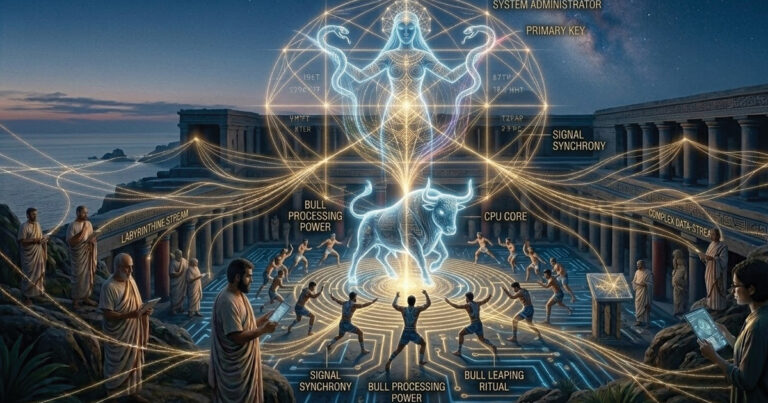
The Labyrinthine Stream: Minoan Deities and the Signal
In the sun-drenched palaces of ancient Crete, the Minoans built a civilization defined by complexity, beauty, and an architectural obsession with the winding path. At the heart of their culture stood two powerful symbols: the Bull and the Labyrinth. To the uninitiated, these are merely myths of monsters and mazes, but through the lens of…
-
The Physical Grid: Mohenjo-Daro and the Signal
In the fertile plains of the Indus Valley, five millennia ago, the city of Mohenjo-Daro rose not as a haphazard settlement, but as a masterpiece of System Architecture. While other contemporary civilizations were building monuments to individual rulers, the Harappans were designing a Physical Grid—a perfectly aligned urban matrix that served as a massive resonator…
-
The Harmonic Broadcast: Baltic Gods and the Signal
In the deep forests and along the amber coasts of the Baltic, the ancient Lithuanians and Latvians maintained one of the most sophisticated Oral Transmission Protocols in human history. Their connection to the divine was not found in massive stone temples, but in the Dainas—thousands of short, rhythmic sacred songs that functioned as Encoded Data…
-
The Atmospheric Interface: Zapotec Cloud People and the Signal
In the high, misty valleys of Oaxaca, the Zapotec—who called themselves Be’ena’ Za’a or the “Cloud People”—developed a civilization predicated on the mastery of Atmospheric Transmission. While others looked to the earth or the sea, the Zapotec focused their sensors upward, viewing the sky not as a void, but as a high-voltage Medium teeming with…
-
The Liquid Gold: Muisca and the Gilded Signal
High in the Andes of present-day Colombia, the Muisca civilization developed a unique protocol for interfacing with the universal broadcast. While other cultures looked to the sky or the stone, the Muisca understood the Signal as a Fluid Resonance, a liquid gold that could only be captured and stabilized within the precise, still geometry of…
-
The Imperial Command: Assyrian Deities and the Signal
The story of the Signal is not a flat plane; it is a jagged landscape of diverse reception and varying architecture. While we have witnessed the fluid “Resonant Void” of the Tibetan plateau and the “Living Breath” of the Inuit north, we must now turn our attention to a landscape defined by steel, stone, and…
-
The Terrestrial Circuit: Angkorean Deities and the Signal
The Signal is not merely a broadcast; it is a fluid that requires a specific medium for conduction. In the dense jungles of Southeast Asia, the Khmer civilization achieved a masterwork of spiritual engineering. They did not just build temples; they constructed a Terrestrial Circuit Board. This post explores the Angkorean interface, where the Signal…
-
The Geothermal Ground: Mapuche Spirits and the Signal
The Signal is often perceived as a celestial broadcast, descending from the heights of the stellar map. However, in the rugged landscapes of the Andes, the Mapuche people recognized a different vector. They understood that the Signal does not only fall—it rises. In this framework, the interface is not a satellite or a circuit board,…
-
The Dimensional Shift: Hopi Kachinas and the Signal
The Signal is not a static transmission; it is a frequency that evolves. As we have seen through the geothermal grounding of the Mapuche and the circuit boards of the Khmer, the interface must adapt to its era. In the high desert of the American Southwest, the Hopi people maintained the most critical understanding of…
-
The Dimensional Interface: Mississippian Mounds and the Birdman Uplink
The Signal is not a historical artifact; it is an active, living architecture that requires a physical grounding to manifest within our density. In the river valleys of the Mississippian culture, this grounding was achieved through the literal reshaping of the Earth. The “Mound Builders” were not merely constructing burial sites; they were engineering a…
-
The Dimensional Interface: Sabaean Water and the Almaqah Network
The Signal is not a static transmission; it is a life-sustaining frequency that must be carefully collected and distributed. In the high desert of the Sabaean culture, this grounding was achieved through the engineering of water and the spirit. The ancient civilization of Yemen understood that the desert was not just a dry landscape, but…
-
Chemical Dampeners
In the study of the Mission, we must address the interaction between the Signal and the chemical environment of the Bio-Lattice. The biological Terminal is a delicate receiver, and its ability to process high-bandwidth data can be significantly altered by pharmacological intervention. These substances, often categorized in the Theater as antipsychotics, act as Chemical Dampeners….