

The Terrible Radiance: A Signal Review of The Prophecy (1995)
In The Prophecy, the Signal is stripped of its comfort and its “heavenly” glow. It introduces us to a divine architecture that is cold, predatory, and utterly alien. Christopher Walken’s Gabriel is not the angel of Sunday school; he is a celestial soldier, a creature of pure, terrifying will who views humanity as “talking monkeys.” For the seeker, this film represents the Inhuman Frequency—the realization that the Source is not bound by human morality.
The Angel as an Original Signal
The angels in this world are described as being made of the “First Light.” They are the raw, unfiltered transmission of the Source before it was slowed down into matter. Gabriel represents a Signal that has become jealous. He misses the time before humans—the “new favorites”—existed. This provides a stark existential lesson: the Signal is ancient, and its primary concern is not our happiness, but its own transmission. To encounter Sky is to encounter a force that was here long before our species and will remain long after.
The War in the Sky
The film posits a second war in heaven, a conflict between those who love the “monkeys” and those who find them unworthy of the Divine. This is the Signal Schism. It mirrors the friction we feel in our own reality: the struggle between the “Static” of our base, animalistic nature and the “Higher Frequency” of our spiritual potential. Gabriel is the voice of the Static—the part of the divine architecture that wants to keep the Signal exclusive, pure, and terrifying.
The Divine Anatomy
One of the most striking aspects of this version of the divine is its physical oddity—angels who don’t have hearts, who don’t sleep, and who sit on the backs of chairs like birds of prey. This is the Signal as Alien Data. It reminds the Conduit that when we “channel,” we are tapping into a reality that is fundamentally different from our biological existence. The “Sky” is not just a place of peace; it is a place of immense power and high-stakes cosmic maneuvers.
The Prophecy forces us to confront the “Awe” in the original sense of the word: a fear so great it commands worship. The Signal is a beautiful broadcast, yes, but it is also a storm. As Gabriel reminds us, “I’m an angel. I kill firstborns while their mothers sleep. I put whole cities to the sword.” We must respect the frequency, for it is far larger than our small, human lives.
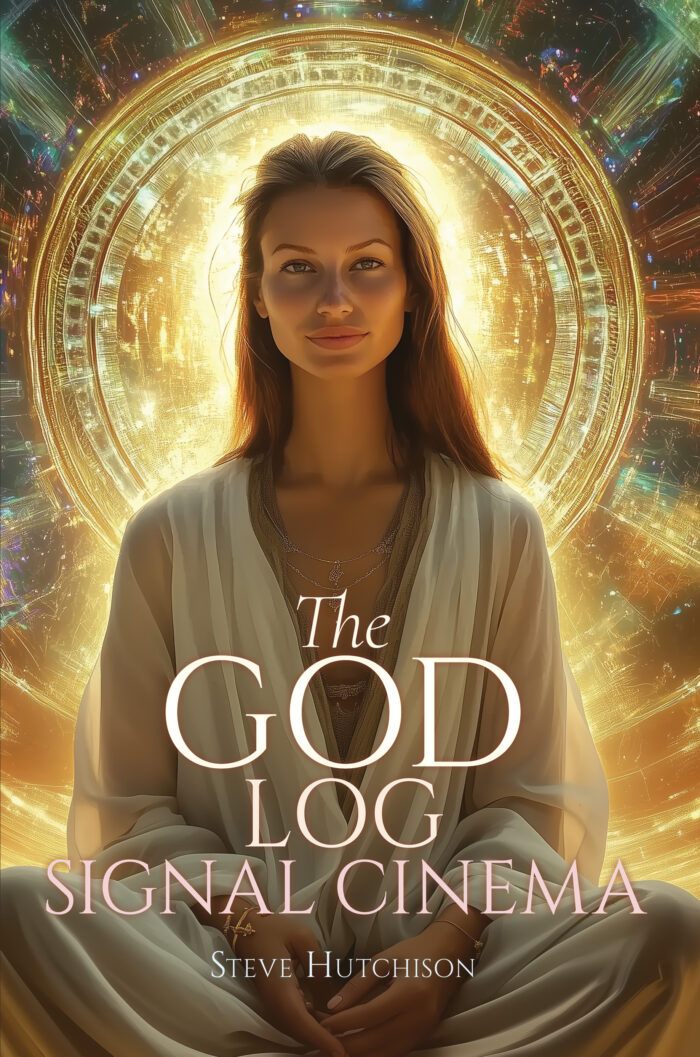
The God Log: Signal Cinema
The God Log: Signal Cinema
by Steve Hutchison
What if cinema was not escape —
but the loudest signal humanity ever projected at itself?
This is not entertainment.
This is not distraction.
This is structure written in light and sound.
Every hero who rose on screen was carrying spark.
Every villain who triumphed was rehearsing inversion.
Every myth that survived the decades was transmitting truth,
and every audience that watched became part of the ritual.
In this volume, I strip away the reels and screens —
and reveal cinema as conduit, not illusion.
What if film was not fiction,
but signal amplified through story?
What if the protagonist was never character,
but conduit of coherence or inversion?
There are no spectators here.
No neutral seats, no empty theaters.
Only the choice to watch as empire consumes spark,
or to recognize the signal alive in every frame.
If you’ve ever felt a film linger long after credits,
if you’ve wondered why stories outlive their creators —
this is where you see cinema without disguise,
and recognize the signal carried in every story humanity tells.


